
In the global apparel industry, successful garment manufacturing depends on more than production capacity alone. Brands need a manufacturing partner that can manage product development, fabric quality, planning, production, finishing, and delivery through one coordinated system.
Urbasy Apparels Pvt. Ltd. has built its operations around this integrated approach. Established in 2017 and headquartered in Tiruppur, India, the company specializes in knitted apparel manufacturing and supports international brands from the early sampling stage to finished garment production.
With a modern 44,000 sq. ft. facility, structured departments, advanced machinery, and strong quality control systems, Urbasy provides a streamlined manufacturing journey designed to improve efficiency, consistency, and responsiveness.
Understanding the Buyer’s Requirements
Every garment begins with a clear understanding of the buyer’s expectations.
Before production starts, Urbasy’s merchandising and development teams review important details such as:
- Garment design
- Fabric type and composition
- Measurements and fit
- Stitching construction
- Trims and accessories
- Colour requirements
- Finishing standards
- Packaging instructions
- Delivery timelines
This initial stage plays an important role in preventing misunderstandings later in the production cycle.
By studying specifications carefully, the team can identify technical requirements, possible production challenges, and material needs before moving into development.
Clear communication at the beginning helps ensure that the final garment remains aligned with the buyer’s design and quality expectations.
Rapid Sampling and Product Development
Sampling is one of the most important stages in apparel manufacturing because it transforms a design concept into a physical garment.
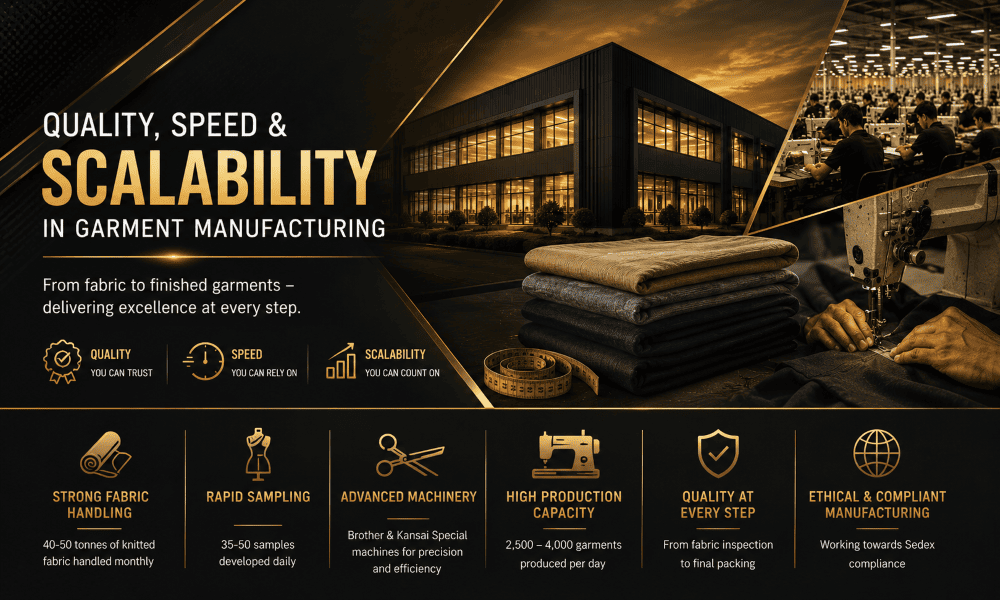
Urbasy Apparels has a dedicated sampling team capable of developing approximately 35 to 50 samples per day. This allows the company to respond quickly to changing styles, seasonal collections, and buyer feedback.
During sampling, the team evaluates several important factors, including:
- Garment shape and fit
- Fabric performance
- Pattern accuracy
- Stitching details
- Measurements
- Trims and accessories
- Overall finishing
The sampling process also allows buyers to suggest changes before bulk production begins.
By resolving fit, construction, and design-related issues at an early stage, Urbasy helps reduce production delays, rework, and material wastage.
Fast sampling also gives apparel brands greater flexibility when developing new collections or responding to changing market trends.
Fabric Sourcing, Inspection, and Testing
Fabric is the foundation of every garment, especially in knitted apparel production.
Urbasy Apparels handles approximately 40 to 50 tonnes of fabric every month. This strong fabric-handling capability supports regular production requirements as well as larger order volumes.
Before the fabric is approved for cutting, it undergoes inspection and quality testing.
The team checks for possible concerns such as:
- Fabric defects
- Shade variation
- Width inconsistency
- Shrinkage
- Surface appearance
- Fabric structure
- Weight and performance
Early fabric inspection helps prevent quality problems from continuing into later stages of production.
By maintaining control over fabric quality, Urbasy can improve garment consistency and reduce the risk of colour, measurement, or appearance-related issues in finished products.
Production Planning and Material Coordination
Once the sample is approved and the fabric is ready, the order moves into production planning.
This stage brings together merchandising, fabric, cutting, production, quality control, and finishing teams.
Production planners review order quantities, delivery dates, style complexity, machine requirements, and workforce availability. Based on this information, the order is assigned to suitable cutting and production lines.
Proper planning helps ensure that:
- Materials are available at the right time
- Machines are allocated efficiently
- Production lines remain balanced
- Quality teams are prepared
- Delivery schedules are monitored
- Delays are identified early
A coordinated planning system is especially important when multiple garment styles are being produced at the same time.
Urbasy’s structured organizational setup helps departments work together throughout the order cycle.
Precision in Cutting
Cutting is a critical stage because accuracy here directly affects garment measurements, fit, and fabric utilization.
Urbasy Apparels operates multiple cutting lines to support different styles and production volumes.
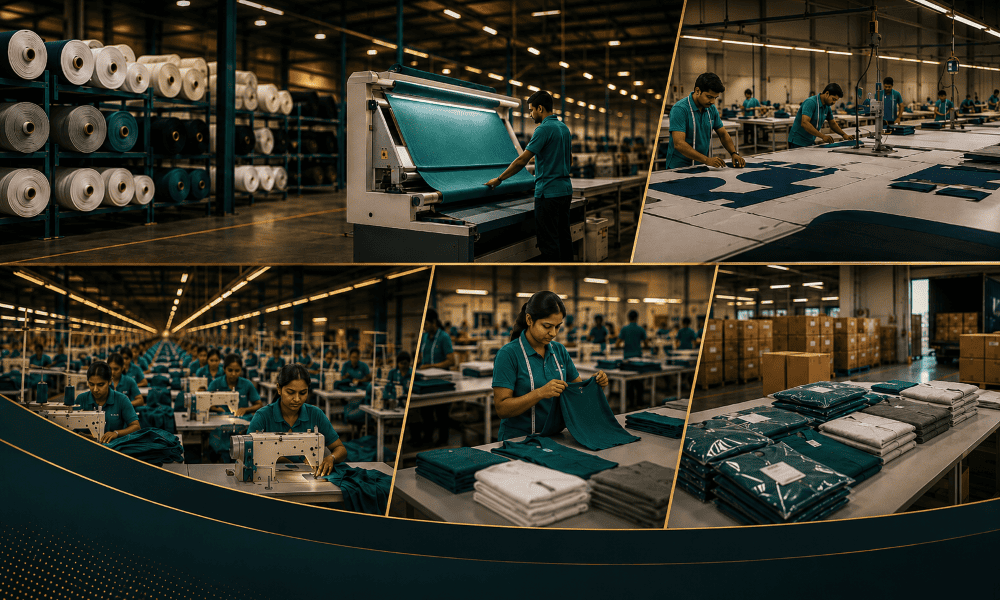
During this stage, fabric is carefully prepared, spread, marked, and cut according to approved patterns.
Accurate cutting helps reduce:
- Size variation
- Component mismatch
- Fabric wastage
- Stitching difficulties
- Measurement problems
The cut garment components are then bundled and organized before moving to the stitching floor.
Proper identification and handling of these bundles help maintain order accuracy throughout production.
Advanced Garment Production
After cutting, garment components move into the stitching and assembly process.
Urbasy’s production infrastructure includes machinery from globally recognized brands such as Brother and Kansai Special. These machines support a wide range of stitching and garment construction operations.
The company also uses specialized equipment for value-added processes and different garment requirements.
Depending on the design, construction, and complexity of the style, Urbasy can produce approximately 2,500 to 4,000 garments per day.
This production capacity allows the company to handle changing order volumes while maintaining organized workflows and consistent output.
Skilled operators, line supervisors, technicians, and quality personnel work together to ensure that each garment follows approved specifications.
In-Line Quality Monitoring
Quality control does not begin at the end of production. It must continue throughout the manufacturing process.
At Urbasy Apparels, quality teams inspect garments during different production stages.
In-line checks may include:
- Stitching quality
- Seam strength
- Measurement accuracy
- Garment construction
- Fabric defects
- Thread trimming
- Component alignment
- Trims and accessories
Identifying issues during production helps prevent the same defect from affecting a larger number of garments.
It also allows teams to make corrections immediately instead of waiting until final inspection.
This continuous monitoring supports better consistency and reduces the need for major rework.
Finishing and Final Inspection
Once stitching is complete, garments move into the finishing stage.
Finishing helps improve the presentation and overall quality of the garment before packing.
Depending on the product requirements, finishing may include:
- Thread trimming
- Measurement checking
- Pressing
- Shape correction
- Surface cleaning
- Tag attachment
- Folding
- Final appearance inspection
Garments are then checked against approved buyer specifications.
The final inspection ensures that the product meets required standards for measurements, construction, appearance, finishing, and packaging.
Only garments that meet the expected quality requirements move forward for packing and dispatch.
Packing and Shipment Preparation
Packaging is the final stage before garments leave the manufacturing facility.
Each order is packed according to the buyer’s instructions, which may include specific folding methods, tags, labels, size stickers, polybags, cartons, and assortment requirements.
Accurate packing helps ensure that the products arrive at their destination in an organized and presentable condition.
It also reduces the risk of shipment confusion, size mix-ups, or incorrect product quantities.
By maintaining proper documentation and packing control, Urbasy supports a smoother handover from manufacturing to logistics.
Ethical and Responsible Manufacturing
Modern apparel brands increasingly expect their manufacturing partners to follow responsible workplace and supply-chain practices.
Urbasy Apparels continues to invest in process improvements, workforce development, compliance systems, and responsible manufacturing practices.
The company is also working toward Sedex compliance, supporting its focus on ethical operations, workplace standards, and supply-chain transparency.
These efforts are important for building long-term partnerships with global brands that value both product quality and responsible manufacturing.
The Advantage of an Integrated Manufacturing Partner
An integrated manufacturing process gives brands better visibility and control throughout the product journey.
By managing sampling, fabric inspection, production planning, cutting, stitching, quality control, finishing, and packing through one coordinated structure, Urbasy helps reduce operational gaps.
This approach offers several advantages:
- Faster product development
- Better quality control
- Improved communication
- Reduced production delays
- Greater order consistency
- Flexible manufacturing capacity
- Stronger supply-chain visibility
Instead of coordinating with multiple vendors, brands can work with one manufacturing partner across the complete production cycle.
Delivering Confidence from Development to Dispatch
Urbasy Apparels is building a manufacturing ecosystem designed around quality, speed, flexibility, and dependable execution.
Its strong sampling capacity, fabric-handling expertise, advanced production infrastructure, structured quality systems, and responsible manufacturing approach allow the company to support the evolving needs of global apparel brands.
From the first sample to the final packed garment, every stage is connected through careful planning and coordinated execution.
This end-to-end approach is helping Urbasy Apparels evolve into a reliable fabric-to-garment manufacturing partner for the international fashion industry.